

Last Updated: October 30, 2026
Quick Summary
What makes high quality hoodies durable is the combination of quality yarn, tight knit density, and solid construction rather than fabric weight alone. Look for double-stitched seams, ring-spun long-staple cotton or an 80/20 cotton-poly blend, and a dense brushed or loopback interior that resists pilling and shrinkage.
- Single-stitched seams split under tension, so choose double-stitched or coverstitched main seams.
- Durable knits typically run 10 to 12 stitches per inch; fewer than 8 signals a weak seam.
- Aim for a pilling resistance rating of 4 or better on the 1 to 5 scale.
- Wash in cold water on a gentle cycle and air dry to prevent shrinkage and pilling.
- A pre-shrunk hoodie should show less than 3 to 5% shrinkage after repeated washing.
Table of Contents
- Why Some Hoodies Fall Apart After a Few Washes
- The Best Material for Hoodies and How Blends Compare
- Hoodie Fabric Weight and GSM: Reading the Numbers
- How to Tell If a Hoodie Is Good Quality Before You Buy
- Durability Across Repeated Washing and Drying
- How to Wash a Hoodie Without Shrinking
- Repairability, End of Life, and Matching Fabric to Use Case
- Picking a Durable Hoodie From Lucky Bear
- Frequently Asked Questions
Why Some Hoodies Fall Apart After a Few Washes
Most hoodies don't fail because of one dramatic flaw. They fail slowly, at the seams and in the fleece, until a favorite layer turns into a shapeless rag. Understanding what makes high quality hoodies durable starts with knowing where cheap construction breaks down.
Three failures account for most early hoodie deaths:
- Seam failure. Single-stitched side seams and shoulder seams split under tension. Double-stitched seams and reinforced stress points hold.
- Pilling. Short, loose fibers work free of the knit and ball up under friction. Longer-staple yarns and tighter knits resist it.
- Shrinkage and shape loss. Loosely knit fabric and high heat during laundering pull a hoodie out of shape permanently.
None of these show up in a product photo. They show up in the fabric and the stitching, which is exactly where a smart buyer looks before spending money.
The Best Material for Hoodies and How Blends Compare
The best material for hoodies balances softness, strength, and shape retention, and no single fiber delivers all three. Cotton feels great and breathes well but can shrink and pill when the yarn is low quality. Polyester adds resilience and color retention but can feel slick. A blend is often where a practical balance lives.
Cotton, Polyester, and the 80/20 Blend
An 80/20 blend is fabric made from roughly 80% cotton and 20% polyester, and it's the workhorse of durable hoodies. The cotton supplies softness and breathability; the polyester adds abrasion resistance and helps the garment hold its shape through repeated laundering. Pure cotton hoodies can be excellent when the yarn is long-staple and the knit is tight, but budget all-cotton fleece tends to pill and shrink faster.
Fleece Construction and Brushed Interiors
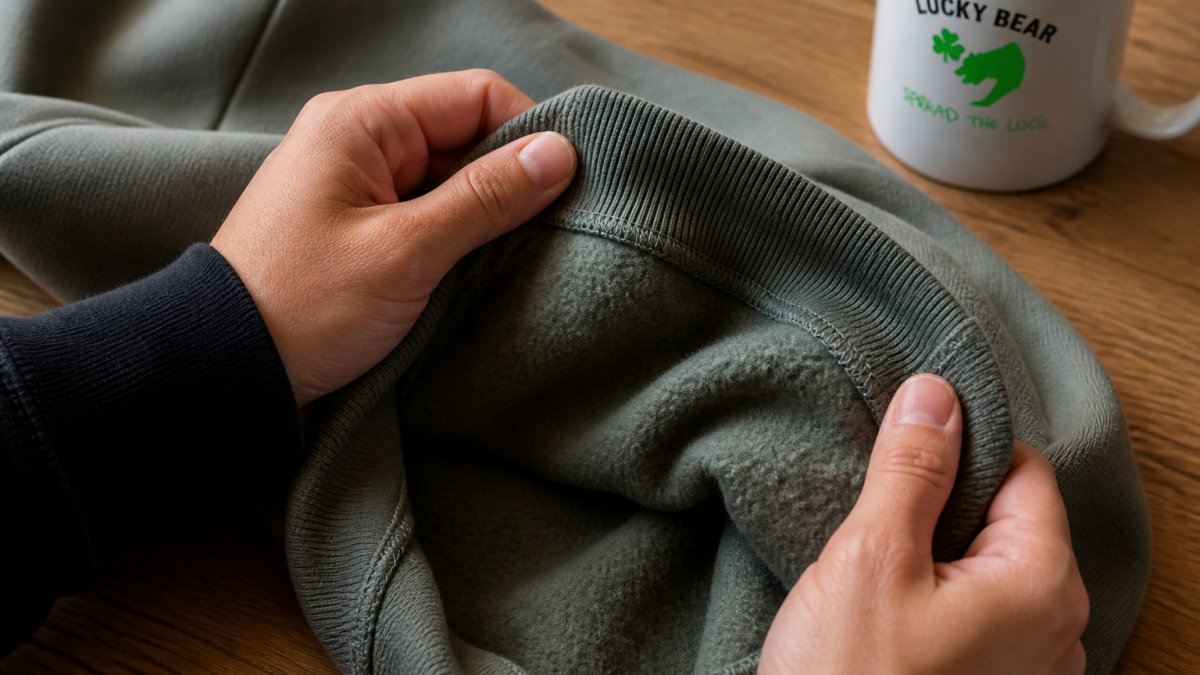
Fleece construction matters as much as fiber content. A brushed interior, where the inside of the fabric is mechanically roughened to create loft, delivers warmth and softness.
Hoodie Fabric Weight and GSM: Reading the Numbers
Hoodie fabric weight and GSM tell you how much fabric you're actually getting. GSM stands for grams per square meter, a standard measure of fabric density.
Here's how the ranges break down in practice:
| Weight Class | Typical GSM | What It Means |
|---|---|---|
| Lightweight | Under 250 | Thin, layer-friendly, less durable |
| Midweight | 250-350 | Everyday hoodies, decent structure |
| Heavyweight | 350-450 | Dense, warm, holds shape well |
| Extra heavyweight | 450+ | Workwear-grade, stiff at first |
Heavyweight versus lightweight isn't just about warmth. A denser knit can resist abrasion and pilling better because fibers are packed tighter. The trade-off is break-in time: very heavy fleece can feel stiff until a few washes soften it.
Why GSM Alone Doesn't Guarantee Durability
A 400 GSM hoodie can still pill, shrink, and fall apart if the yarn and knit structure are poor. Fabric weight is a starting point, not a verdict. Three factors determine whether that weight translates into longevity:
- Yarn quality: Long-staple cotton (like Supima or Egyptian cotton) and ring-spun yarns create stronger, smoother threads with fewer loose ends. Short-staple, open-end yarns are cheaper but shed fibers and pill faster. Two hoodies at the same GSM can differ dramatically based on yarn staple length.
- Knit density: GSM measures mass per area, but not how tightly the loops are packed. A loosely knit 400 GSM fleece can be less abrasion-resistant than a tightly knit 350 GSM one. Look for a dense, uniform hand feel and minimal see-through when held to light.
- Fleece construction: The interior brushing process matters. Aggressive brushing on short fibers creates a plush feel but generates loose ends that pill. Quality brushed fleece uses longer fibers and a tighter knit so the interior stays soft without shedding. Some durable hoodies use a loopback or French terry construction instead of brushed fleece, which resists pilling better at the cost of some initial softness.
How to Use GSM Without Being Fooled
Use GSM as one filter alongside other checks. A practical approach:
- Check the yarn and knit: Look for ring-spun cotton or a cotton-poly blend with a tight knit. If the brand doesn't disclose yarn type, feel for smoothness and density.
- Inspect the interior: A tight, uniform brushed interior or a loopback terry is a better durability sign than a thick but loosely brushed fleece.
How to Tell If a Hoodie Is Good Quality Before You Buy
A hands-on inspection can reveal a lot about a hoodie's durability, but knowing what to measure makes the difference between a quick feel and a real assessment. Flip it inside out, check the seams, and feel the fabric density.
A Construction Inspection Checklist
Run through this list before you commit, and where possible, put a number or a physical test behind each item:
- Seams: Look for double-stitched or reinforced seams at the shoulders, armholes, and side seams. Single stitching is a red flag. On a durable hoodie, the main seams should be sewn with a coverstitch or a double-needle stitch, not a single row of lockstitch.
- Stitching density: Count stitches per inch (SPI) along a straight seam. Most durable knits run 10-12 SPI; fewer than 8 SPI signals a loose, weak seam that will grin open under tension. Check for skipped stitches and loose threads.
- Cuffs and waistband: Ribbed cuffs and a sturdy waistband should snap back, not stretch out limply. Stretch the cuff about 2 inches and release it; it should return to shape within a second. A slow or incomplete recovery means the elastane or rib structure is weak.
Objective Durability Tests You Can Run or Ask About
Beyond the visual checklist, durability can be assessed with standardized tests that brands sometimes publish or that you can approximate at home:
- Abrasion resistance: The Martindale test (ASTM D4966) rubs fabric against an abrasive surface and reports the number of cycles before wear-through. Higher cycles mean better abrasion resistance. A sturdy fleece might withstand 20,000-30,000 cycles; a flimsy one may fail far sooner.
- Pilling resistance: The Martindale pilling test (ASTM D4970) or the random tumble pilling test (ASTM D3512) rates pilling on a scale of 1-5, with 5 being no pilling. Ask for a rating of 4 or better for a hoodie you expect to last.
- Seam strength: Seam slippage and seam strength tests (ASTM D1683) measure how much force a seam can take before it pulls apart. A durable hoodie should have seams that hold under firm hand tension without grinning.
A common mistake is judging a hoodie by its exterior print or logo. The construction inside is what determines whether it survives a year of wear. When a brand publishes test results or fiber content and construction details, that transparency is itself a quality signal.
Durability Across Repeated Washing and Drying
Laundering is where durability gets tested hardest, and most hoodie damage happens in the dryer, not the washer. Heat can break down fibers, accelerate shrinkage, and encourage pilling.
Spread the Luck Classic Unisex Heavyweight Hooded Sweatshirt →
To extend lifespan, wash in cold water on a gentle cycle, turn the garment inside out, and skip the dryer in favor of air drying.
Watch out: drying a heavyweight fleece hoodie on high heat is the single fastest way to shrink it and set in permanent pilling. You can also learn habits that stop hoodie pilling before it starts.
How to Wash a Hoodie Without Shrinking
You can wash a hoodie without shrinking it by using cold water, a gentle cycle, and low or no heat during drying. Heat and agitation are the two culprits behind shrinkage and shape loss, and controlling both keeps the fabric close to its original size.
Follow these steps:
- Turn the hoodie inside out and close any zippers.
- Wash in cold water on a gentle or delicate cycle with a mild detergent.
- Skip fabric softener and bleach.
- Reshape the hoodie while damp and lay it flat or hang it to air dry.
- If you must use a dryer, choose the lowest heat setting and remove the hoodie while slightly damp.
Care still matters, whatever the fabric.
Repairability, End of Life, and Matching Fabric to Use Case
Durability isn't only about how long a hoodie lasts; it's about how well it matches your use case and how easily it can be repaired. A heavyweight cotton-poly blend built for cold-weather layering makes a poor choice for hot climates, where breathability matters more than insulation.
Match the fabric to the job:
- Skateboarding and street wear: Midweight to heavyweight blends with reinforced seams.
- Hiking and outdoor use: Denser knits with abrasion resistance and quick-drying fibers. See durable hoodies for hiking for top picks.
- Everyday casual: Midweight blends that balance comfort and structure.
When a hoodie does wear out, simple repairs like re-stitching a seam or patching a small hole can add years of life.
Picking a Durable Hoodie From Lucky Bear
If you want a hoodie that puts these durability principles into practice, our heavyweight hooded sweatshirts are built around them. Both the Lucky Bear Classic Unisex Heavyweight Hooded Sweatshirt and the Spread the Luck Classic Unisex Heavyweight Hooded Sweatshirt feature an ultra-soft brushed interior, a premium heavyweight feel, a relaxed street-ready fit, and durable stitching that holds its shape.


For cooler mountain evenings, the Sierra Summit Unisex Hoodie delivers a soft, smooth fleece with a cozy fit that layers well under a shell. Each is made to order, so your hoodie is produced specifically for you.
Skip if: You need an ultralight, packable layer for hot-weather activity.
Frequently Asked Questions
What is the best material for a hoodie if I want it to last?
A cotton-polyester blend, often an 80/20 blend, tends to hold up best. Cotton gives softness and breathability, while polyester adds strength, abrasion resistance, and color retention. All-cotton hoodies feel great but can shrink and pill more readily; all-synthetic ones resist wear but trap heat. Look for a heavyweight fleece with a brushed interior and reinforced seams. Lucky Bear's heavyweight hoodies are built with durable stitching and a premium heavyweight feel that holds its shape.
Does heavyweight fabric make a hoodie more durable?
Heavier fabric usually means more yarn per square inch, which generally improves abrasion resistance and shape retention. A hoodie fabric weight and GSM around 350 to 450 GSM (roughly 10 to 13 oz/yd²) is a practical heavyweight range. Weight alone is not proof of quality, though: a heavy hoodie with weak single-stitched seams will still fail. Check GSM, knit structure, and stitching together before deciding.
How can I tell if a hoodie is good quality in the store?
Turn it inside out and inspect the seams: double-stitched or reinforced seams at the shoulders, armholes, and waistband resist pulling. Check that cuffs and the waistband snap back rather than staying stretched. Look for even stitching with no loose threads, a brushed fleece interior that does not shed heavily, and a fabric that feels dense rather than thin. A low-shrinkage fleece label and clear care instructions are good signs too.
Can a hoodie last 20 years?
A hoodie can last many years with the right construction and care, though 20 years is an ambitious target and depends on how often you wear and wash it. Heavyweight fleece, reinforced seams, and a stable cotton-polyester blend give the best chance. Washing cold, inside out, and air drying instead of machine drying slows shrinkage, pilling, and fade. Rotating between several hoodies also spreads the wear and tear.
How should I wash a hoodie so it does not shrink or pill?
Wash cold on a gentle cycle with the hoodie inside out and zipped or buttoned if it has closures. Skip fabric softener, which can coat fleece fibers and reduce softness over time. Tumble dry on low or air dry flat to limit shrinkage and pilling. Following the care instructions on the label and avoiding high heat are the two habits that protect fabric weight, color retention, and fit the longest.
What stitching should I look for in a durable hoodie?
Look for double-stitched seams at stress points like the shoulders, armholes, side seams, and where the hood meets the body. Reinforced seams and a sturdy waistband and cuffs keep the shape from stretching out. Even, tight stitching with no skipped stitches or loose threads signals better construction. Flatlock or overlocked interior seams reduce fraying and chafing, which matters for hoodies worn during skateboarding or hiking.
Durable hoodies aren't luck; they're the result of the right fabric blend, dense knit structure, reinforced seams, and smart care. If you're ready to stop replacing worn-out layers every season, explore the Lucky Bear heavyweight hoodie collection, built with brushed fleece interiors and stitching designed to hold its shape wash after wash. Add to cart and experience the difference quality construction makes.
