

Last Updated: November 5, 2026
Quick Summary
The best adventure clothes for travel are built for movement, weather, and storage first, with style as a close second. Start with a packable shell like the $60 Spread the Luck Windbreaker, add one breathable layer, and finish with bottoms that hold your essentials securely.
- The Spread the Luck Windbreaker has a 100% polyester shell with an interior water-resistant coating and runs small, so order a size up.
- The Sierra Sunset Quarter-Zip uses moisture-wicking, odor-resistant polyester knit at 3.8 oz/yd² but has no pockets.
- Black Retro Sunset Shorts use a 91% recycled polyester, 9% spandex blend with a 6.5-inch inseam and UPF50+ protection.
- Crossover Leggings have one pocket on each side and a 74% recycled polyester, 26% elastane fabric with UPF 50+ protection.
- A pocket bag needs at least 7 inches of interior depth and a 4-inch opening width to hold a large phone securely.
Table of Contents
- What Separates Adventure Clothes From Regular Travel Clothes
- Quick Comparison: 7 Travel-Ready Pieces at a Glance
- 1. Spread the Luck Windbreaker: The Packable Layer for Wet Weather
- 2. Sierra Sunset Quarter-Zip: Layering That Breathes
- 3. Black Retro Sunset Shorts: Four-Way Stretch for Long Days
- 4. Crossover Leggings With Pockets: Phone Storage That Stays Put
- 5. Sierra Bear Trip Long Sleeve: Sun Coverage Without the Heat
- 6. Cargo Joggers With Zipper Pockets: What to Look For Before You Buy
- The Bottom Line on Packing Smart
- Frequently Asked Questions
What Separates Adventure Clothes From Regular Travel Clothes
Adventure clothes are garments built for movement, weather, and storage first, with style as a close second. Regular travel clothes often prioritize looks and packing ease. The difference shows up in three places: fabric performance, pocket design, and how the piece handles sweat and rain.
Adventure clothes are built for beach mornings and mountain afternoons in the same day. A cotton tee looks fine in photos and then holds sweat against your back on a climb. Fashion joggers can dump your phone the moment you jog for a bus.
The pieces below solve those problems, and we'll show you why each earns its space in the bag.
Quick Comparison: 7 Travel-Ready Pieces at a Glance
| Piece | Price | Fabric Weight | Pocket Setup | Best For |
|---|---|---|---|---|
| Spread the Luck Windbreaker | $60 | 2.5 oz/yd² | Welt pockets, mesh bags | Wet weather, packable layer |
| Sierra Sunset Quarter-Zip | $35 | Lightweight polyester | No pockets | Layering, breathability |
| Black Retro Sunset Shorts | $35 | 5.13 oz/yd² | Mesh side pockets | Long active days |
| Crossover Leggings | $45 | Soft stretch blend | One pocket per side | Phone storage on the move |
| Sierra Bear Trip Long Sleeve | $27 | Cotton-blend knit | No pockets | Sun coverage, casual wear |
| Cargo Joggers With Zipper Pockets | Varies | Varies | Zippered cargo pockets | Trail to town transitions |
1. Spread the Luck Windbreaker: The Packable Layer for Wet Weather
A packable windbreaker is the single most useful layer in a travel bag, and this one earns the spot. The 100% polyester shell carries an interior water-resistant coating, so a passing shower is less likely to soak through. Fabric weight sits at 2.5 oz/yd².
The details matter more than the headline spec. The jacket has welt pockets with mesh pocket bags, a rubber zipper pull tab, and a three-panel hood with a fine mesh liner.
Watch out: this jacket runs small. Order a size up, especially if you plan to layer it over a hoodie.
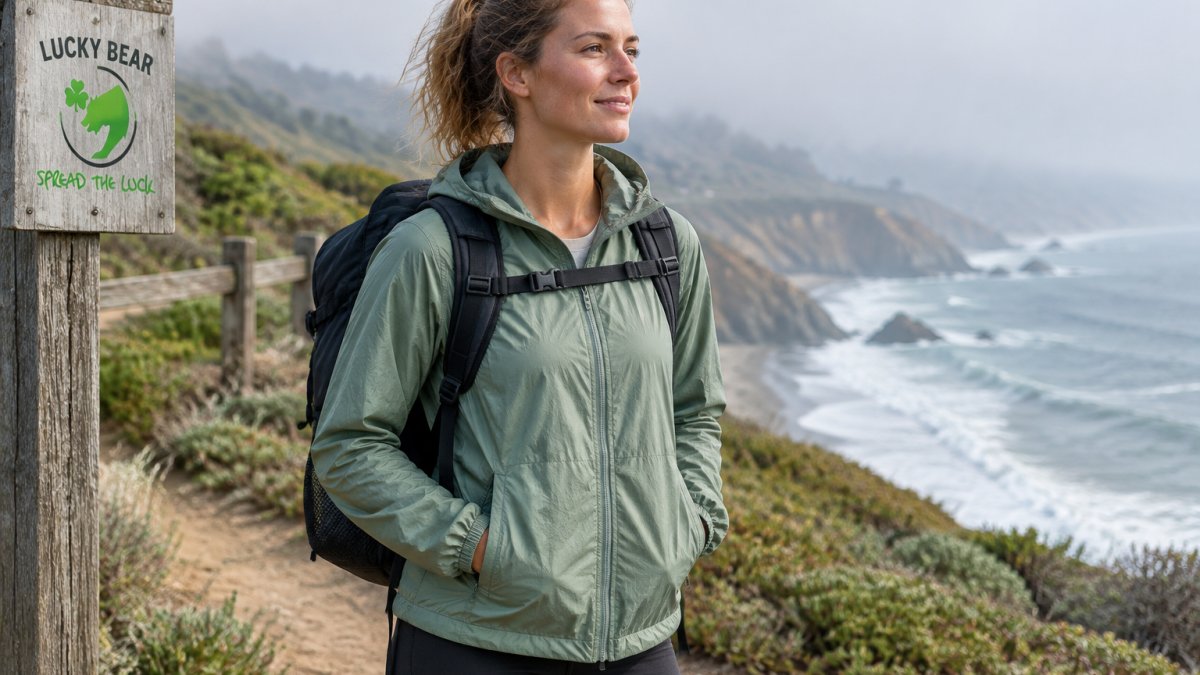
Best for: anyone traveling where rain is possible and bag space is tight. Skip if: you need insulation, because this is a shell, not a warm layer.
You can shop the packable windbreaker in the Lucky Bear store.
2. Sierra Sunset Quarter-Zip: Layering That Breathes
Breathability decides whether a layer stays on past the first mile. This quarter-zip uses a moisture-wicking, odor-resistant polyester knit at 3.8 oz/yd². A cadet collar and color-matching zipper look clean at a trailhead or a coffee shop.
The regular, comfortable fit is designed for everyday wear.
Best for: cool mornings that turn warm by noon. Skip if: you want pockets, because this piece has none.
Browse the Sierra Sunset quarter-zip to pick your size.

3. Black Retro Sunset Shorts: Four-Way Stretch for Long Days
Long days on your feet demand shorts that move with you, and four-way stretch is the spec that delivers it. These shorts use a 91% recycled polyester, 9% spandex blend at 5.13 oz/yd² with moisture-wicking and breathable, fast-drying material. The 6.5-inch inseam and UPF50+ protection are listed features.
Fit and sizing. The shorts have an elastic waistband with a flat white drawstring and a 6.5-inch inseam.
Best for: hiking, swimming, and gym sessions on the same trip. Skip if: you need secure pockets for rough terrain, because mesh side pockets are open.
4. Crossover Leggings With Pockets: Phone Storage That Stays Put
These crossover leggings have one pocket on each side, a high-waisted, flattering cut and a triangle gusset. The 74% recycled polyester, 26% elastane fabric has a soft, stretchy feel with mild compression, plus UPF 50+ protection.
Best for: women who want a high-waisted, fitted legging with side pockets. Skip if: you want a loose fit, because these are fitted by design.
See the crossover leggings with pockets in every available size.
Spread the Luck unisex lightweight zip up windbreaker →

5. Sierra Bear Trip Long Sleeve: Sun Coverage Without the Heat
Sun coverage fails when fabric traps heat, so the goal is a light knit with airflow. This long sleeve is a staple inspired by the Sierra collection, with a graphic design and a straight fit for casual wear.
Sizing runs from S through 3XL.
Best for: casual wear and everyday travel.
Pick up the Sierra Bear Trip long sleeve before your next trip.

6. Cargo Joggers With Zipper Pockets: What to Look For Before You Buy
Zippered pockets turn joggers from loungewear into travel gear, but "zippered" alone tells you almost nothing. The specs that decide whether your phone survives a scramble are pocket depth, opening width, closure type, and how the loaded pocket behaves when you run, bend, and sit.
Pocket capacity, measured. A pocket that holds a phone flat is not the same as one that holds it securely. A current large phone in a slim case runs roughly 6.3 to 6.5 inches tall, 3.1 to 3.3 inches wide, and 0.35 to 0.45 inches thick. A pocket bag needs an interior depth of at least 7 inches and an opening width of at least 4 inches for that phone to sit fully below the opening. For a passport, plan on 8 inches or more of depth. When you try joggers on, drop your phone in, sit down, and check whether the top edge clears the pocket opening; if it peeks above the seam, it will launch on the first hard step.
Closure types and what they are good for. Open slash pockets are fastest to access and worst in motion; fine for a trailhead walk, poor for running. Zippered pockets are the travel default, but quality varies: look for molded plastic or metal teeth, a pull tab large enough to grip with one wet hand, and a zipper garage so the pull does not dig into your hip under a pack belt. Hidden pockets, usually a zip in the waistband or a seam, are the most secure option for a passport or cards but the slowest to reach; treat them as backup storage.
Security during movement. Open pockets often pass a standing test and fail a running test. Before you trust a pair, jog in place for 30 seconds, do a deep bodyweight squat, and sit down fully. If the phone slides toward the opening or the pocket bag swings outward, the pocket is not secure for active use. Cargo styles add side volume but swing more when you run; if you plan to jog for a bus, a flat zippered hand pocket beats a bulky cargo pocket.
Pocket layout trade-offs with a pack. Loaded pockets change how the waistband sits. A phone in a front pocket presses against a hip belt, and a passport in a rear pocket becomes a pressure point when you sit against a pack. On hiking days, move hard items to a hidden waistband pocket or a pack lid and keep hand pockets for soft, light items. Flat-front zippered pockets are more comfortable under a hip belt than cargo pockets, which bunch.
Fit, fabric, and seams. Four-way stretch matters most at the hip and knee, where a loaded pocket pulls fabric tight. Flat-lock seams at the inner thigh reduce chafing, and a cuffed ankle keeps fabric out of puddles. An adjustable waistband lets you tighten the fit when pockets are loaded. Men's joggers with zipper pockets and women's hiking joggers share this checklist; the difference is usually rise and hip shape, so try both cuts if your hip-to-waist ratio sits outside the average.
Sizing and body-shape guidance. Pocket performance changes with size. On larger sizes, a fixed pocket bag may sit higher on the hip and interfere with a pack belt. Check where the pocket opening lands relative to your hip bone and whether the bag is anchored at the bottom, because a loose bag lets contents slide. If you are between sizes, size for the hip and thigh first and use the waistband adjustment second.
Care and durability. Zippers fail at the slider and the pull, not the teeth, so zip pockets closed before washing and avoid high heat in the dryer, which can warp plastic coils. Turn joggers inside out, wash cold, and hang dry. Check seam tape and bar tacks at pocket corners every few washes; a blown pocket corner is how phones get lost.
For a deeper breakdown of pocket depth, fabric, and fit, read our men's joggers with deep pockets buying guide.
The Bottom Line on Packing Smart
Building a travel kit around a few performance pieces beats stuffing a suitcase with duplicates. Start with a packable shell, add one breathable layer, and finish with bottoms that hold your essentials securely. That combination handles rain, sun, and a full day of movement.
Lucky Bear builds California-inspired apparel that celebrates beaches and mountains. Our windbreaker is packable, and our quarter-zips, leggings and shorts are part of our lifestyle line. Add to cart and pack lighter on your next adventure.
Frequently Asked Questions
Are joggers good for hiking and travel?
They can be, provided the fabric stretches and the pockets close. Four-way stretch and moisture-wicking material keep you moving on climbs, and a cuffed ankle stops fabric from dragging on wet ground. The weak point is storage: open side pockets drop phones on steep descents, so look for zippered or deep pockets. For travel days, joggers also pack smaller than jeans and dry faster in a hotel sink.
What features should I look for in travel joggers?
Check four things: pocket depth and closure, fabric weight, waist adjustment, and dry time. A phone should sit fully below the pocket opening, not peek out. Fabric around 5 oz/yd² balances warmth and breathability for three-season trips. An elastic waistband with a drawstring handles airplane bloating and long drives. Moisture-wicking polyester blends dry overnight, which matters when you are packing light.
Are cargo joggers practical for travel?
Yes, if the pockets are secured. Cargo joggers with zipper pockets keep passports, cards, and keys from sliding out in transit, and the extra capacity means you can leave a daypack behind on short outings. The trade-off is bulk: loaded cargo pockets swing against your legs when you run or climb. Keep heavy items in the zippered pockets and leave the flap pockets for light gear like a map or snack.
What fabrics are best for active travel clothing?
Polyester and spandex blends win for most trips. They wick sweat, dry fast, and hold shape after repeated washing. A four-way stretch short in 91% recycled polyester and 9% spandex is made from moisture-wicking, fast-drying material. For layering, a 2.5 oz/yd² polyester windbreaker with a water-resistant coating handles wind and light rain without adding weight to your bag.
